Showing posts with label PhD thesis. Show all posts

Jun 29, 2026

Research Trip to Rome

I spent almost the entire month of June at the Finnish Institute in Rome doing research. I worked on my dissertation and gathered research literature in local libraries. I hadn't planned to visit Pompeii this time, but I ended up there anyway guiding a group of the institute's teacher training course. I also saw many new archaeological sites and museums and much more.

I didn't travel directly to Rome but first spent a couple of days in Munich visiting some famous museums I have long wanted to see. I arrived on Friday May 29th, and during the weekend I admired ancient sculptures in the Glyptothek, other ancient artifacts in the Staatliche Antikensammlungen museum, and more recent paintings in the Alte Pinakothek. I also visited a few churches and went swimming in the Isar River which flows through the city.

Sculptures at the Glyptothek

The banks of the Isar River are popular swimming spots

On Sunday evening, I boarded a night train that went directly from Munich to Rome. I had a single berth, which is apparently a fairly new form of travel. Instead of a four-person cabin, the same space is divided into separate bunks, which are accessed directly from the corridor. The cabin is not the most comfortable in the world – it is a bit difficult to get to the top bunk, the space is quite narrow, the pillow and blanket are thin, a large suitcase has to be placed in a separate carriage – but it offers privacy and peace. The price includes a modest breakfast (coffee/tea and a bread roll with spreads). From the small window in the cabin, I watched the nighttime alpine landscape and illuminated villages as the train meandered along the Austrian mountains.

There was storage space for small items in the compartments between the beds

Fortunately, I had my own pillow with me on the trip

After a somewhat restless night's sleep, I arrived in Rome on Monday morning at around 11 am (a little behind schedule). From there, I headed to Villa Lante, which I saw for the first time since the renovation. The house and its courtyards look mostly the same as before, but they have received a considerable facelift. From the resident's perspective, the most important change is the air conditioning in the guest rooms, which really came in handy during the June heat. Another significant difference is the residents' kitchen, which has been moved from the upper floors of the dormitory down to the ground floor where the former caretaker's apartment was. This change is welcome, even though reaching the kitchen now requires climbing down the stairs a few floors. The noise from the kitchen doesn't disturb the residents, and there is direct access to the pleasant new backyard terrace. The institute's other gardens are now also freely available to the residents.

I stayed in an apartment that is usually used by an artist at the institute.
It had a separate study and a private bathroom!

The new resident's terrace

The main reason for my trip was to work on my dissertation in the libraries of Rome. I had a long list of research literature that I had not been able to get my hands on elsewhere, most of which I knew could be found in Rome. The library of Villa Lante had some of these, but the collections most relevant to my research are in libraries such as the American Academy in Rome and the Deutsches Archäologisches Institut (DAI). I visited these several times. The American Academy has become particularly familiar because it is just a stone's throw from Villa Lante on the Gianicolo hill. The DAI, on the other hand, is further away on the other side of Rome. During my month-long stay, I found almost everything I was looking for and many works that I was not aware of.

The library of Villa Lante

The library of American Academy

An interesting conference was held at the Swedish Institute in Rome during my visit to Rome (see program). The conference was themed after the recently deceased Swedish scholar Bengt E. Thomasson. I attended a few lectures which included discussions on Thomasson’s life’s work, Swedish epigraphic research, and the connections between epigraphy and epigrammatic poetry. I also met scholars who, like me, are studying inscriptions and the poems of Martial.

During the first two weeks of June, a course for teachers of history and social studies was held at Villa Lante, led mainly by the institute’s vice director. Many of us visiting scholars were also asked to participate in the course by giving lectures and guiding the group. I had the opportunity to take the participants to Pompeii where we spent a sunny Friday. At the end of the tour, we happened to meet an American research team who were presenting their excavation project to the public. They were acquainted with Finnish researchers from Villa Lante, and one of them said he was interested in Pompeian insults. I promised to contact him later.

Guiding teachers in Pompeii. Photo: Olli Taskilahti

Archaeologist Allison Emmerson presenting their project
investigating one city block in Pompeii (I 14)

Our group stayed overnight in a hotel in the center of modern Pompeii, where we saw, among other things, campaign events for the local mayoral election. Next day, I guided the group through the Naples Archaeological Museum. After the guided tours, I stayed in Naples with a colleague while the teachers headed back to Rome. On Sunday, we visited Herculaneum and the nearby Reggia di Portici palace, which served as the first storage site and museum for the Herculaneum finds in the 18th century.

Herculaneum

The Reggia di Portici palace now houses
the Faculty of Agriculture of the University of Naples

Although I have spent a total of almost two years in Rome in varying periods, there is always something new to see there. This time I got to see, among other things, a Roman necropolis under the Vatican parking garage, Roman houses and parts of an aqueduct under modern houses near the Trevi Fountain, the museum exhibitions at the stations of the new subway line C, the newly opened museum in the Basilica of Neptune behind the Pantheon, and the renovated museum of Ostia. We also visited the Cinecittà studios, where a huge number of Italian and international films and TV series have been filmed. The most interesting thing was getting a guided tour of the sets depicting ancient Rome, where, for example, HBO's Rome and Ridley Scott's Gladiator have been filmed. The Rome Pride also took place in June. This was the fourth time I attended the event.

The Vatican necropolis


Remains of a Roman house and other artifacts
at the new subway station by the Colosseum

The set of ancient Rome at Cinecittà studios

Rome Pride 2026

I also had time to visit the Porta Portese market

In addition to working and sightseeing, an essential part of living at the institute are its residents, with whom it was again a pleasure to spend these weeks in Rome. Some were old acquaintances, but I got to know many new ones during shared dinners and excursions. The meetings with other researchers were also important. Once again, the visit to Rome gave me much more than I expected. Still, it was nice to return from the heat of Rome to Finland for my summer holidays.

The institute's summer party was held mid-June

Ice cream helped me cope on the hottest days

Dec 2, 2023

Research and Conference Trip: Rome – Ostia – Pompeii

My previous visit to Italy had been more than a year ago, so it was time to head back there in early November. I had several good reasons for my trip. I was going to participate in a conference on ancient identities, where I'd present a paper related to my research. In addition to this, I was going to visit a couple of archives to advance my research on Ostia and to explore two recently opened private houses in Pompeii that contained material that was of interest for my doctoral research. My trip was funded by Svenska Kulturfonden and the Finnish Institute in Rome. I'm thankful for their support.

I flew to Rome early on Monday morning on 6 November, and immediately headed to the BiASA archive at the Palazzo Venezia in the center of Rome, hoping to examine materials related to the late 19th century excavations in Ostia. I had confirmed in advance via email that the materials should be available. However, upon reaching the archive I was informed that the archive room I was looking for was only open on Tuesdays and Thursdays. I would have to come back the next day. Calculating that I would have time to return to the archive on Tuesday afternoon, I spent the rest of the day exploring the center of Rome and returned to my accommodation early to catch up on sleep.

A moment of reflection after my unsuccessful visit to the BiASA archive

I had arranged a visit to the archives in Ostia on Tuesday morning to study materials related to my research on the theater of Ostia. This visit went as planned. I had been to Ostia a couple of times before to read excavation reports from the early 20th century (previously in my blog: Searching for the Theatre of Ostia in the Archives). This time I mainly verified some details in the reports and supplemented my notes.

My visit to the archives of Ostia was more successful.
You can see me almost smiling.

I returned from Ostia in the afternoon and hurried back to the BiASA archive. However, this time I was told that the archive room I wanted to visit was only open until two o'clock on Tuesdays and Thursdays, and it was already half-past two. The members of the staff tried to find a solution, and I was asked to wait for a moment. Soon, a person whom I understood to be the director of the archive arrived. She wanted to know what was going on and why I hadn't contacted her in advance. I tried to explain this with my poor Italian. After some discussion and animated gesturing and sighing, she reluctantly agreed to let me into the archive. Two very friendly archivists helped me find the material I was looking for, which turned out to be much more extensive than I had imagined. I examined some late 19th-century photographs and a watercolor painting of the theater of Ostia and realized it would be better to come back at a more suitable time.
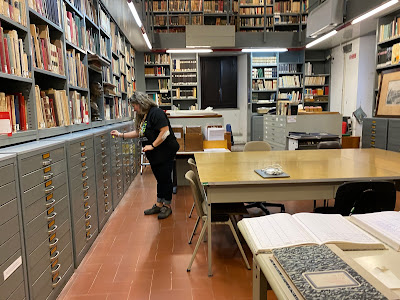
At the BiASA archive in the tower of Palazzo Venezia

With Jasmin and Maria at the Porticus Octaviae

On Tuesday evening, I met my fellow researchers Maria and Jasmin, and we went for aperitifs and dinner. We had all come to Rome to participate in the Arachne IX conference entitled "Gender, Identities, and Social Structures in Greco-Roman Antiquity". The conference was organized by the Nordic Arachne network, founded by Finnish and Swedish researchers interested in ancient gender studies. Most participants were from Finland and Sweden, but there were researchers from many other countries including North America and Australia.

Wine reception at the Swedish Institute in Rome

Keynote lecture by Marjatta Nielsen at the Finnish Institute in Rome

The conference was mainly held at the Swedish Institute in Rome, but we also had the opportunity to visit the temporary facilities of the Finnish Institute in Rome. During the conference, we heard presentations on gender ideals, the status of women in antiquity, aging, professions, and ethnic identities among many other topics. I presented a paper on the Roman attitudes towards disreputable professions such as gladiators, actors, and prostitutes.

Me presenting my paper. Photo: Iida Huitula

After the conference on Friday, I took a train to Naples. I had planned to visit Pompeii to see two private houses that had recently been opened to the public after extensive restoration. These houses contain material relevant to my research. I was at the gates of Pompeii early on Saturday morning, rushing straight to my first destination, the so-called House of the Vettii. There I studied wall paintings and inscriptions likely related to prostitution conducted in the house. Similarly explicit paintings have been found only in a handful of Pompeian houses.

The peristyle garden of the House of the Vettii

The backroom decorated with explicit wall paintings,
perhaps a space for prostitutes to conduct their business.

A graffito advertising the services of a woman called Eutychis,
scratched on the wall of the entrance to the house.

Priapus, the god of fertility, painted on a wall near the entrance.

My second destination was the so-called House of the Silver Wedding, one of the largest private houses in Pompeii. It is also one of the few houses where numerous graffiti are still visible on the walls. Many of these are sexual insults and therefore important for my research. I knew the location of some inscriptions, but I had to search for others. A few enthusiastic custodians of the house helped me in my search. We found at least two phallic drawings.

The atrium of the House of the Silver Wedding

A graffito phallus on the wall of the peristyle.
The drawing is only a few centimeters wide.

This room that opens to the peristyle garden has
about a dozen graffiti still visible on the walls.

Calling someone a fellator

It was very enlightening to see these scribblings with my own eyes in their original environment. Many of them were written on the walls of a room located on one side of the large peristyle garden (see the photos above). This room was perhaps used as a dining room, which makes you wonder who wrote them in that particular place and why. As I explored the room, many passers-by stopped to stare curiously at me while I worked. I had conversations with some of them about the wall inscriptions, including a local archaeologist and an American couple.

The Forum Baths were open to the public again.
The photo is from the tepidarium, one of the warm rooms.

Many tourists visit Pompeii with guides whose expertise is not always impressive. During this visit, I heard one guide telling their clients that probably at least 10,000 people died when Pompeii was destroyed. Researchers usually estimate around 2,000 victims. Another guide claimed that the great brothel of Pompeii had thousands of graffiti on its walls. She may have exaggerated on purpose. Only some 120 inscriptions have been documented in the brothel. I also had to correct the archaeologist I met in the House of the Silver Wedding, who claimed that at least 90% of the inscriptions were obscene. Only a few hundred of the over 10,000 graffiti documented in Pompeii contain indecent language. Reality is sometimes less sensational than we would like to imagine.

For the first time I got to climb on top of one of the towers of the city wall.
The view is to the south towards the forum.

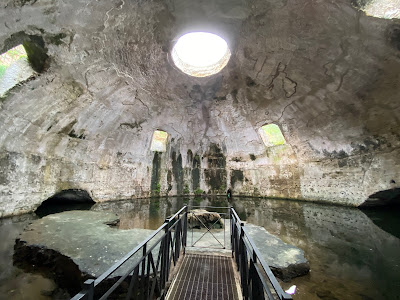
Before my trip I had applied for permission to access the storerooms of the Archaeological Museum of Naples to study wall inscriptions stored there. However, the museum never responded to my request, so I had to come up with other plans for Sunday. I took a bus to the western end of the Bay of Naples to visit the archaeological site of Baiae, which was a popular vacation spot for the Roman elite. There I saw the ruins of imperial-era baths, among which is the oldest surviving dome built by the Romans. The acoustics in this round room, later filled with water, were incredible. I also visited the archaeological museum located in a castle built on a hill by the bay in the late 15th century.

The archaeological area of Baiae consisting of multiple baths built on the slopes of a hill

The domed space probably originally served as a frigidarium, a cold bath.
The room has later become partly submerged due to seismic activity.

On Monday morning I returned to Rome by train, where I spent a few hours wandering around the city. In the evening I flew back to Finland satisfied with a successful conference and research trip.

Jun 5, 2023

Conference Trip: Prejudices, Phalli and Fun

I attended a conference on classical studies in Cambridge in April together with four other Finnish scholars. Last summer we took part in a cultural history conference in Verona, and we wanted to continue our collaboration. Soon after the conference in Verona we saw the call for papers for the conference in Cambridge. We invited a couple more scholars to apply with us and drew up a proposal of two panels on otherness and prejudice in antiquity. Our panels were accepted and we received travel grants that enabled us to travel to the conference on 21st to 23rd April 2023. First and foremost we want to thank the Finnish Institute in the UK and Ireland for giving each of us a TelepART grant. The conference programme can be seen here. All photos are my own unless noted otherwise.

Can you find the Finnish delegates?
(photo: Zoe Audra)

The conference was organized by the Classical Association, which has supported teaching of and research within classical studies for over 120 years, together with the Faculty of Classics at the University of Cambridge. An estimated 500 scholars and teachers attended the conference. Academic papers were offered in multiple parallel sessions so you had to choose the most interesting ones. The most memorable presentation for me was the first one I listened to at the beginning of the conference on the Cambridge Greek Lexicon. The topic didn't sound very exciting but professor emeritus James Diggle recounted the history and the editorial process of the lexicon so vividly and entertainingly that I enjoyed the talk immensely. This was a good example of how any topic can be turned into an interesting talk when presented the right way.

Professor emeritus James Diggle giving a talk on the
Cambridge Greek Lexicon.
We had our first panel session (me, Jasmin and Maria) right away on Friday afternoon. We presented papers on stereotypes between the Romans and other peoples. I gave a paper on how Martial's satirical poems reflect Roman prejudices about the Greeks (Powerpoint slides here). Our papers were well received and led to a lively discussion. After our successful panel we got to enjoy the rest of the conference as participants. Juha, Saara and the British member of our panel Eddie had their turn on Saturday morning. Their panel examined the topic of otherness in the Greek world expertly from various points-of-view.

Our panel: Maria Jokela, Jasmin Lukkari and me.
(photo: Cédric Scheidegger Lämmle)

Presenting Martial and Roman prejudices against the Greeks.
(photo: Juha Isotalo)

The panel of Juha Isotalo, Saara Kauppinen and Eddie Jones.

In addition to the daily talks and sessions we had the opportunity to visit the archaeological museum of the Faculty of Classics and the Fitzwilliam Museum, where an evening reception was held in honor of the 120th anniversary of the Classical Association. During the conference I met many scholars and a few of them had very similar research interests which might lead to some kind of collaboration in the future. I also met many old acquaintances whom I had met in previous conferences and when I lived at the Finnish Institute in Rome. I'm gradually starting to feel like a part of the international research community.

The archaeological museum of the Faculty of Classics.
The collection consists of all kinds of plaster copies.

Fitzwilliam Museum

We had a chance to explore the collections of the museum during the reception.

I'd never been to Cambridge before so I spent some time getting to know the city. Those famous neogothic college buildings were everywhere. I visited King's College whose chapel is more like a gothic cathedral, at least to the eyes of tourist from Finland (where we don't have any gothic churches). There were many great book stores but, unfortunately, I couldn't fit that many volumes in my luggage. I regret not buying a 19th century edition of Martial's poems that I saw in one antiquarian book shop. It wouldn't have been very useful in my research but it would have made a fine addition to my collection of Martial-related books.

King's College

King's College Chapel

River Cam

After the weekend in Cambridge we traveled to London where we stayed for two days after the conference. We spent most of Monday exploring the British Museum. I've visited the museum a couple of times before but there still much to see, especially items that I hadn't paid attention to on my previous visits that pertain to my PhD research. I'd made a list beforehand of the collections and went around looking for some specific items. I was particularly interested in portrayals of men and women, foreign peoples, and professions such as actors, gladiators and physicians. Visual presentations of these groups are often found in sculptures, paintings and small decorative items. I also wanted to study items related to gender and sexuality such as phalli and portrayals of the god Priapus. Here are some examples from the collections:

An overly realistic portrayal of an old woman.

Lamp with a depiction of a woman sitting on phallus while standing on a crocodile.
According to the museum this may be a caricature of Cleopatra VII.
(photo: British Museum Collections)

Lamp with a satirical depiction of surgical operation.
The physician is holding the patient's penis on an anvil
with a pair of forceps. A hammer is waiting on the floor.
(photo: British Museum Collections)

The so called Warren Cup; a silver drinking cup
with depictions of male-to-male erotic scenes.

Playful satyrs.

Golden finger rings with phalli. Judging by the small size
of the rings these were most likely worn by children,
probably as a protection against the evil eye.

A bronze wind chime in the form of the god Priapus.

We even had time for some entertainment during our stay in London. On Monday evening I got to see the musical Hamilton. I was a bit sceptical about the combination of historical drama and rap music, but I have to say I liked the musical very much. On Tuesday morning we had some time to walk around the sunny Kensington Gardens before we left for the airport. In the evening we flew back to Finland.

Hamilton Musical

Juha and the Kensington cherry blossoms

A toast to a successful conference!

This group of scholars has become important to me in many ways, not the least because we always have so much fun together. Our shared research interests academic ambitions connect us to each other too. Already on our way to Heathrow airport we started to talk about which conference we should attend next. Or should we perhaps organize a seminar or a workshop of our own where we could continue discussing our research topics?

The Finnish delegates at the conference:
me, Jasmin Lukkari, Juha Isotalo, Maria Jokela and Saara Kauppinen.