Showing posts with label Roman daily life. Show all posts

Oct 28, 2023

'Escape from Pompeii' Exhibition at Maritime Centre Vellamo

We visited the 'Escape from Pompeii' exhibition at the Maritime Centre Vellamo in Kotka about a month ago. The exhibition was open from April to September. We organized the trip together with Turku Classical Association Paideia, Palladion association, and the students of Turku Classical High School. Here is a brief report of the trip.

'Escape from Pompeii' exhibition

We set off early in the morning by bus from Turku and arrived in Kotka around noon. Two guided tours were arranged for us for the exhibition, one for the high school students and the other for the rest of the group. While waiting for our own guided tour, we explored the other exhibitions at Vellamo, which were also worth seeing.

Maritime Centre Vellamo

The guided tour was pretty good, but it didn't add much to what one could learn just by studying the objects, exhibition texts, and other materials. The guide also seemed a bit nervous upon hearing that there was a Pompeii scholar in the group. I tried to be encouraging and only corrected the guide at one point when she presented the plaster casts of two victims from Pompeii, claiming that these had been left under the lava.

The guided tour

In my opinion the exhibition was well-executed and diverse. The collection on display mainly consisted of authentic objects brought from Italy to Finland. These included sculptures, wall paintings, inscriptions, everyday objects, and jewelry, among other things. The selection was complemented with items from Finnish museum collections originating from Pompeii, which are seldom on display.

A fresco probably depicting the ancient port of Puteoli (now Pozzuoli).

A sculpture of Dionysus

A Pompeiian phallus amulet that belongs to the
archaeological collections of the Finnish Heritage Agency

The high-quality and clear information signs were written in three languages, and I didn't find any significant errors in them. The museum texts also highlighted recent scientific discussions, such as the timing of the destruction of Pompeii, i.e. whether the eruption of Vesuvius in AD 79 happened in August or October. This question was left open.

The exhibition effectively utilized various multimedia elements. At the beginning of the exhibition, a video installation depicted the eruption of Vesuvius and how people in antiquity interpreted such volcanic phenomena.
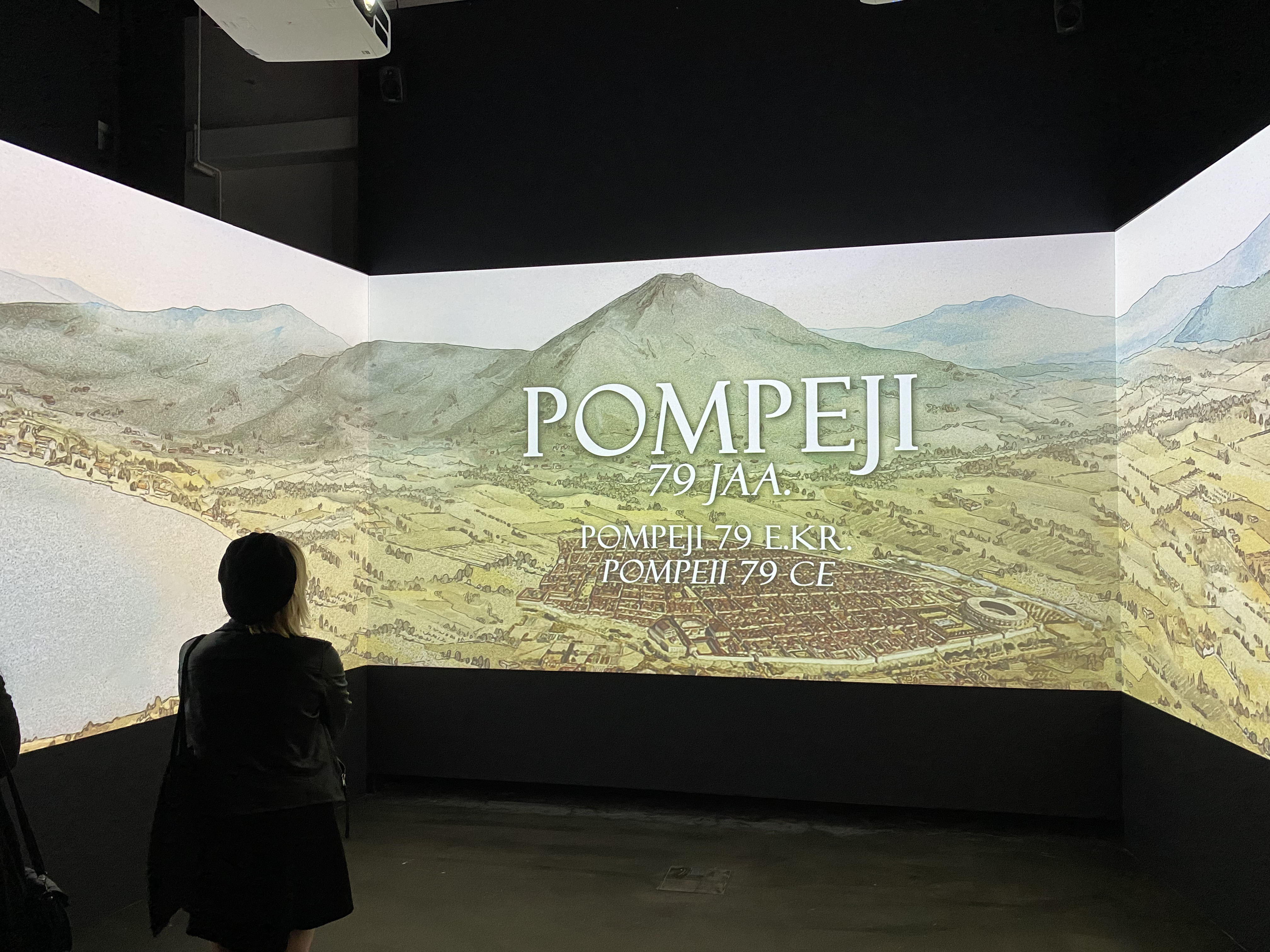
The video installation depicting the eruption of Vesuvius in AD 79

Through video material, a maritime archaeological project was presented which involved the recovery of bronze rams of Roman warships in the Mediterranean. One video, projected on a wall, featured a 3D-modeled interior of a Pompeiian private house, while another video showcased colorful Pompeiian wall paintings that might otherwise have been challenging to include in the exhibition.

A 3D model of the so-called House of Caecilius Iucundus in Pompeii.

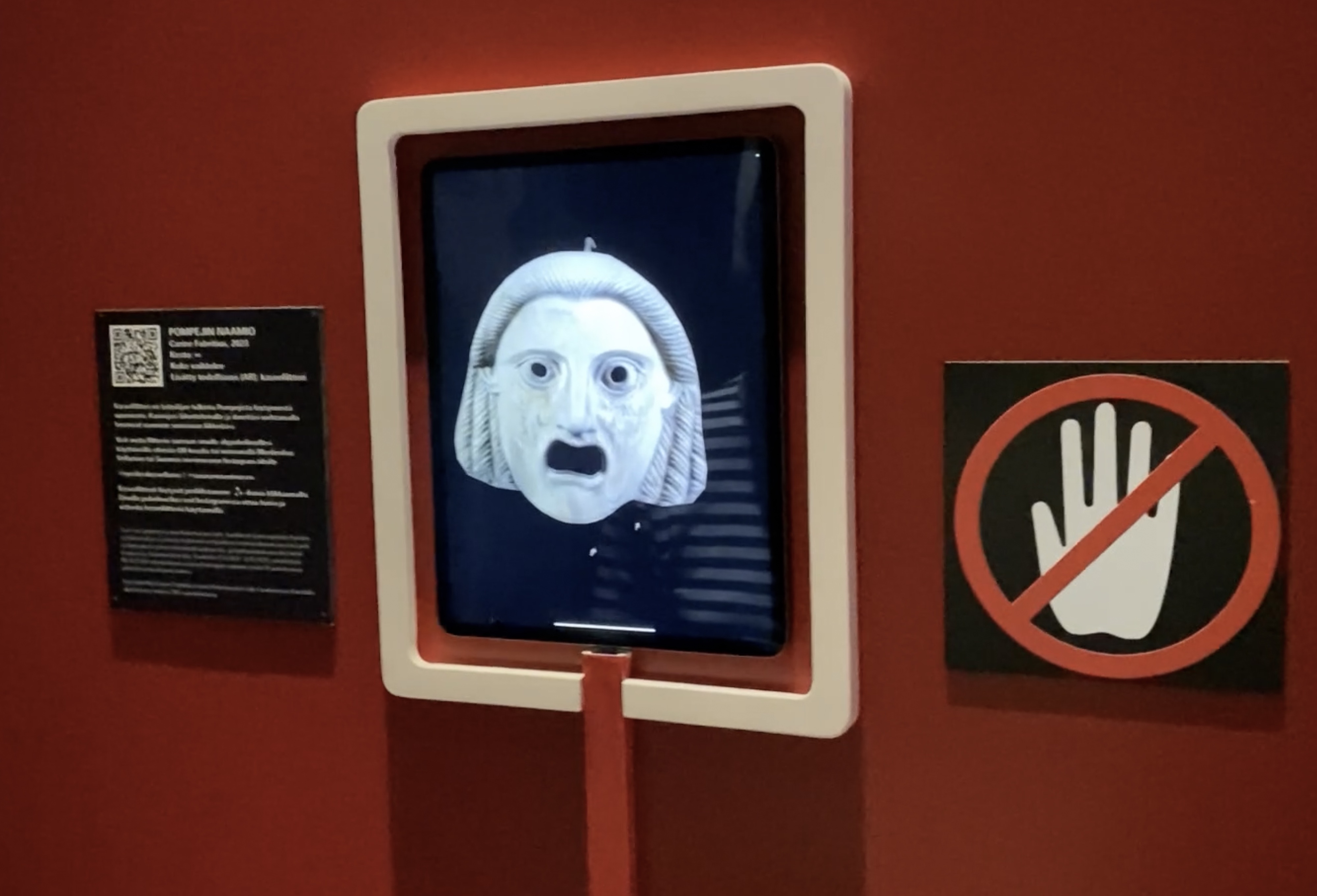
An creative way to present the buildings of Pompeii and Herculaneum was a video panel lying on the floor. It displayed the locations of the buildings on maps of the cities at the same time as images of these structures were projected onto the wall above. The exhibition also featured a virtual theater mask created by a Finnish visual artist Carine Fabritius, which mimicked the viewer's facial movements and expressions.

A virtual map of Pompeii

A virtual filter representing a Pompeiian mask.
You can try the filter on Vellamo's Instagram profile by opening
the tab marked with three stars, where you will find the filter.
Note that it only works on the mobile app.

There were some minor points of criticism as well. The presentation of objects was not always very clear. For instance, objects retrieved from the Bay of Naples were gathered in a large showcase and described in a rather general manner. The items were not numbered, which could make it unclear for the average museum visitor to discern which among them were, for instance, parts of an anchor, a weight, or a wine skin.

Items retrieved from the Bay of Naples

The connection to maritime activities seemed somewhat thin, even though the exhibition did highlight the role of the Roman navy in rescue operations during the eruption of Vesuvius and the significance of maritime trade in the daily life of the inhabitants of the area. On display were inscriptions that shed light on the lives of sailors, objects related to trade, and a scale model of a Roman merchant ship.

A Roman merchant vessel of the horeia type, 1/5 scale.

I would have liked to see some Pompeian wall inscriptions in the exhibition, but this time they were not included. One at least was incorporated into the 3D model of a Pompeiian private house. The model seemed to be made with enough care that this graffito was, to my understanding, roughly in the right place on the wall.

Graffito:
Whoever loves, let him flourish.
Let him perish who knows not love.
Let him perish twice over whoever forbids love.
(Translation: Alison Cooley & M. G. L. Cooley)

The exhibition was well worth seeing and effectively highlighted the daily life of Pompeian residents and how this life ended so abruptly because of the disaster. We had the opportunity to spend a pleasant Saturday immersed in the world of Pompeii, which is a rare treat in Finland.

Apr 15, 2021

The Happy Life according to Martial

Reading Martial's poems one inevitably gets the impression of a cynical poet who writes satirical poems about the vices and social injustices he sees around himself. Most of his production does belong to this genre. Lately, however, I've come to notice and appreciate Martial's positive descriptions of life, which stand out even more when they are placed among all the insults and satire. Martial was a master of variation and juxtaposition. His poems on the good and happy life convey a philosophy of life that is simple and down-to-earth, and which he himself followed in his life – at least to a certain extent.

Cyclamen at Hadrian's Villa in Tivoli
One piece of advice that Martial offers is to live in the moment. The same idea was coined by Horace in the phrase carpe diem. Martial manages to form even this theme into a satirical poem that is addressed to one Postumus. His name was chosen to fit the theme, as it means late-born or one who has been born after his fathers death.

You say you will live tomorrow, Postumus, always tomorrow.
Tell me, that tomorrow, Postumus, when is it coming?
How far off is that tomorrow, where is it, or where will you go to get it?
Is it hiding in Parthia or Armenia?
That tomorrow of yours is already as old as Priam or Nestor.
How much, tell me, would that tomorrow cost to buy?
Will you live tomorrow? It’s already overlate, Postumus, to live today.
He is wise, Postumus, who lived yesterday.
(Mart. 5.58)

Worrying about tomorrow sounds familiar. I usually manage to fill my calendar for many weeks ahead and constantly think about things I need to take care of. When do I learn to stop and enjoy the moment a bit more?

A detail of a fresco from Pompeii, a banquet scene
A detail of a fresco from Pompeii
Perhaps the most well-known of Martial's descriptions of the happy life is the one he sent ot his friend Julius Martialis:

Most delightful Martialis,
the elements of a happy life are as follows: 
money not worked for but inherited; 
land not unproductive; a fire all the year round;
lawsuits never, a gown rarely worn, a mind at peace; 
a gentleman’s strength, a healthy body;
guilelessness not naive, friends of like degree, 
easy company, a table without frills; 
a night not drunken but free of cares; 
a marriage bed not austere and yet modest; 
sleep to make the dark hours short; 
wish to be what you are, wish nothing better; 
don’t fear your last day, nor yet pray for it.
(Mart. 10.47)

Martial's ideal life resembles the one prescribed by epicurean philosophy, where happiness is found through moderate pleasures and simple life. Riches and other excesses should be avoided. Towards the end of his life Martial withdrew from Rome to his hometown of Bilbilis in Spain, where he could live his last years according this ideal. This is how he described his days to his friend Juvenalis, who may be the well-known Roman satirist Juvenal:

While you perhaps, Juvenal, 
wander restlessly in noisy Subura
or tread Lady Diana’s hill,
while your sweating gown fans you
as you cross the thresholds of the powerful 
and the Greater and Lesser Caelian tire out the wanderer: 
me my Bilbilis, proud of her gold and iron, 
revisited after many Decembers, 
has received and made a rustic. 
Here in idleness I exert myself pleasantly
to visit Boterdus and Platea
(such are the uncouth names in Celtiberian lands).
I enjoy an enormous, indecent amount of sleep,
often unbroken till past the third hour,
and pay myself back in full now
for my vigils of thirty years.
The gown is unknown, but when I ask
I am handed the nearest garment to hand from a broken chair.
When I get up, a fireplace welcomes me 
stocked with a proud pile of logs from an adjacent oak wood
and crowned by the bailiff’s wife with many a pot. 
The huntsman comes next, but one that you 
would like to have with you in a secret grove. 
The smooth-skinned bailiff gives my boys their rations 
and asks me to let him cut his long hair. 
So fain would I live, so fain would I die.
(Mart. 12.18)

Martial no longer needed to wear the toga, which was used by Roman men while taking part in public affairs. Juvenalis, on the other hand, still had to suffer the noise and heat of Rome, while Martial could enjoy the peace and quiet of his country villa. I wouldn't mind some of this peace and quiet in the midst of all the research and other duties. At least summer is coming soon and with it holidays at our cottage or sailing in the archipelago.

Street view of Italica near Seville, a paved road lined with cypress trees
Street view of Italica near Seville
Life in Spain, however, wasn't all to Martial's liking. This simple life lacked the civilized atmosphere that he was used to in Rome, and the audience to whom he had written his poems. This is how Martial explains to his friend Priscus why he hasn't published more poems during his stay in Spain:

The first and most important point is that I miss the ears of the community to which I had grown accustomed. It is like pleading a case in a strange court. For if there is anything to please in my little books, the audience dictated it. The subtlety of judgments, the inspiration of the themes, the libraries, the theaters, the gatherings where pleasure is a student without realizing it, to sum it all up, all those things which in my fastidiousness I forsook, 1 now regret as though they had deserted me. (Mart. 12, preface)

Martial missed the inspiration provided by the city of Rome and the literary circles there, even though he enjoyed the quiet of the countryside. All the aspects of a happy life were not attainable for him at the same time.

I sometimes wish that I could avoid all the tedious duties and just concentrate on more enjoyable things such as friends, pastimes and other simple joys of life. The pressures of work and academic performance are often stressful. On the other hand, I can't imagine my life without intellectual pursuits such as studying new things or doing research. Still, it's good that Martial's poems remind me that work and duties should be balanced with other things in life.


Translations of Martial's poems: D. R. Shackleton Bailey Martial: Epigrams, Loeb Classical Library, Harvard University Press, 1993.

Photos: Joonas Vanhala

Dec 13, 2020

Saturnalia – A Roman Christmas?

It is soon time for the most important holiday of the year. For many of us it's Christmas. For the Romans it was Saturnalia that was held in honor of Saturn on 17th to 23rd of December. Catullus called this festival the "best of days". These two holidays share many customs, some of which were transferred directly from Saturnalia to the Christian celebration of Christmas. Some traditions, on the other hand, such as the obscene verses associated with Saturnalia were substituted with other forms of entertainment over the centuries.

Saturnalia was a merry and cheerful festival. People had time off from work and school. Many social norms were turned upside down during Saturnalia. Slaves could be free for a period and were served by their masters at dinner. A king of the Saturnalia, Saturnalicius princeps, was chosen by lot for the duration of the festival. He presided over the festivities and people had to obey his orders.

Temple of Saturn in the Roman Forum

The festivities began on the first day of Saturnalia with a sacrifice and a great banquet at the temple of Saturn in the Roman Forum. The banquet was open to all, songs were sung and people shouted io Saturnalia. After the official ceremonies the holiday continued in private for several days. People visited friends and family, gave gifts to one another, ate, drank and played games. Some traditional Saturnalian dishes included pork and mulsum, wine flavored with honey and spices, that resembles modern mulled wine.

The Roman poet Martial describes many of these Saturnalian customs in his poems:

While the knight and my lord senator rejoice in dinner suits and the wearing of the cap of liberty befits our Jupiter, while the slave as he shakes the dice box does not fear to look at the aedile, though he sees the cold pools so close: accept these lots, alternately for the rich man and the poor man; let each one give his guest the appropriate prize. – – (Mart. 14.1.1–6)

In stead of the customary toga one could wear synthesis, a garment that was usually worn only at dinner. In addition, a cap called pilleus, a sign of a free man, was worn by all. The dice refer to gambling that was permitted during Saturnalia but was normally prohibited.

Noppapeliä kuvaava fresko Pompejista
Game of dice in a Pompeian fresco

The Romans had a custom of giving gifts to their guests at parties and during festivals such as Saturnalia. Such gifts included food items, clothes, jewelry and toys for instance. Typically Saturnalian gifts were the small wax or clay figurines called sigillaria. Gifts were often accompanied by short verses. Martial published two collections of such poems (Xenia and Apophoreta) and wrote verses for gifts such as a toothpick, a broom, ivory tusks, a sponge, a strainer for snow, and slaves including a wrestler, a boy, a stenographer, a confectioner and an idiot. Some gifts were more expensive than others.

The verses were often satirical and described the gift:

Toothpick: Mastic is better; but if a leafy point is not available, a quill can relieve your teeth. (Mart. 14.22)

Strainer for snow: Take my advice, dilute your Setine cups with my snow. You can stain linen with an inferior wine. (Mart. 14.103)

Stenographer: Though the words speed, the hand is faster than they. The right hand has finished its work, while the tongue has more to do. (Mart. 14.208)

Idiot: His stupidity does not lie, is not feigned by wily art. He that is witless to excess has his wits. (Mart. 14.210)

Roomalainen norsunluinen nukke 100-luvulta jaa.
An ivory doll from the 2nd century AD.

Jesting and satire were an essential part of Saturnalia. Martial wrote many of his poems specifically for the festival. For example, his 11th book of epigrams was published during the Saturnalia of 96 AD. This is the most satirical of Martial's books. He describes his own verses in this way:

On the sumptuous feast days of the old Scythe-bearer, over which King Dice-box rules, methinks you allow me, cap-clad Rome, to sport in toil-free verse. You smile. Permission granted then, I am not forbidden. Pale cares, get you far hence. Whatever conies my way, let me out with it and no moody meditation. – – (Mart. 11.6.1–8)

The festival of the Scythe-bearer (i.e. Saturn) was a good excuse for writing obscene verses. Martial, however, felt the need to defend himself, and noted that his epigrams don't represent his morals but the customs of Saturnalia.

I have writings that Cato’s wife and severe Sabine dames might read. But I want all of this little book to laugh and be naughtier than all little books. Let it be soaked in wine nor blush for the stains of rich Cosmian pomade, let it play with the boys, love the girls, and name outright that from which we are born, the universal parent, which holy Numa used to call “cock.” But remember, Apollinaris, that these are Saturnalian verses. This little book does not have my morals. (Mart. 11.15)

Martial wrote Saturnalian verses such as these:

The column that hangs from Titius rivals in size the one that the girls of Lampsacus honor [= Priapus]. He bathes in spacious baths, his own baths, with none to accompany or incommode him. And yet Titius hasn’t room to bathe. (Mart. 11.51)

Lesbia swears that she has never been fucked free of charge. It’s true. When she wants to be fucked, she is accustomed to pay cash. (Mart. 11.62)

He lies, Zoilus, who says you are vicious. You are not a vicious man, Zoilus, you’re vice. (Mart. 11.92)

After the Christian holiday of Christmas was placed on December 25th in the fourth century, many of the customs of Saturnalia were taken over by the Christians and gradually incorporated into their celebration of Christmas. Such traditions as drinking, gambling and electing a "king of misrule" remained as part of the festivities of Christmas in Europe for centuries. Here in Scandinavia the influence of Saturnalia was never as great as within the former Roman empire. Nonetheless, many of our Christmas traditions such as gift-giving, eating together and singing songs resemble the customs of the Roman Saturnalia.


Sources:

Hänninen Marja-Leena & Maijastina Kahlos, Roomalaista arkea ja juhlaa, SKS, 2004.

Polkunen Marja-Liisa, Martialis: Venus, viini ja vapaus – epigrammeja, Otava, 2000.

"Saturnus, Saturnalia", The Oxford Classical DictionaryOxford University Press, 2012.

Translations of the poems of Martial:

Martial. Epigrams, Volumes I–III, ed. & trans. D. R. Shackleton Bailey, Loeb Classical Library, Harvard University Press, 1993.

Photos: temple of Saturn (Joonas Vanhala, 2018), game of dice in a Pompeian fresco (Wikimedia Commons), an ivory doll at Centrale Montemartini, Rome (Joonas Vanhala, 2018)

Oct 28, 2020

Insults on the Walls of Pompeii

I'm again reading through the corpus of Pompeian insults that I've gathered for my research, and I decided to give you some examples. A word of warning: lots of obscenities ahead!

Most of the insults refer to sexual behavior. Over two thirds of the insults that I've studied mention sexual acts or organs. A few of the most common terms of abuse in graffiti are fellator (cocksucker), cunnilingus (cuntlicker) and cinaedus (a passive homosexual, a penetrated male). There are also many references to prostitution although many of these graffiti are advertisements and not insults.


Martialis is a cuntlicker. (CIL IV 1331, line drawing in the photo above)

Lucilia made a profit with her body. (CIL IV 1948)

Ianuarius is a faggot (cinaedus). (CIL IV 2334)

Ionis sucks cock. (CIL IV 2403)

Physical appearance was another popular category of insults. Attention is drawn to features that were regarded as suspect or shameful such as hairlessness or those associated with overt sexual activity. Many caricature drawings have also been found. 

Peregrinus + caricature drawing (CIL IV 1810, in the photo)

Epaphra, you are bald (or: hairless). (CIL IV 1816, in the photo)

Phileros is dickless (or: a eunuch). (CIL IV 1826)

Euplia has a loose vagina and a huge clit. (CIL IV 10004)

Bodily functions were also considered shameful, which is shown by the many insults referring to disease and bodily fluids.

Secundus shits here, shits here, shits here. (CIL IV 3146)

Here I fucked a girl with a beautiful body. She was praised by many but inside of her there was muck. (CIL IV 1516)

Chius, I hope that your piles become inflamed so that they burn worse than they did before. (CIL IV 1820)

Slightly more tame are the insults adressed to thieves or the ones comparing people with animals. There are only a few of these among the graffiti, which is probably because they weren't considered as effective as insults as other terms of abuse.

Labicula is a thief. (CIL IV 4776, in the photo)

Oppius, you're a clown (emboliarius), a thief and a petty crook. (CIL IV 1949)

Brutus is a dog. (CIL IV 10093c)

In many graffiti the insulted person is called worthless or no good in various terms:

Samius to Cornelius: go hang yourself! (CIL IV 1864)

Ephebus, you're a busybody (ardalio). (CIL IV 4765)

Somene is vile (nequam). (CIL IV 8322k)

Some of the insults are more original and skillful stylistically. Many were written in poetic meter, e.g. in elegiac couplets such as number 1516 above (translation not in meter). Some resemble letters such as number 1852 that seems to have a tone of irony.

Pyrrhus greets his colleague Chius. I'm sad to hear you've died. So, be in good health! (CIL IV 1852, in the phot)

Gaius Adius Ventrio, a Roman knight, was born between a beet and a cabbage. (CIL IV 4533)

Some categories of insults that are common in other sources such as Roman rhetoric and comedy, are not found in Pompeian graffiti. These include ethnicity and profession for instance. The Romans had stereotypical and prejudiced views of foreign peoples and shameful professions, but these don't feature on the walls of Pompeii as insults. Same goes for many of the most common terms of abuse in Roman comedy such as stultus (stupid) which isn't found even once in Pompeian graffiti.

As to why this is, is an open question and one that I study in my PhD research. One of the aims of my research is to explain the choice of subject matter in Pompeian insults by examining the social, literary and historical context of these insults and the stereotypes exhibited in them.


Source of the photos and graffiti: CIL IV = Corpus inscriptionum Latinarum, vol. 4, Berolini 1871–.